This article compares the 2026 Mazda CX-30 and the 2026 Honda CR-V — two five-passenger crossover SUVs from Mazda and Honda — for northern New Jersey drivers choosing between a subcompact crossover and a compact SUV. The CX-30 is a subcompact crossover with standard i-ACTIV AWD, 186 horsepower, available turbocharged performance up to 250 horsepower, 8.0 inches of ground clearance, and a listed starting price of $25,975. The CR-V is a larger compact SUV with 39.3 cubic feet of cargo room behind the second row, 41.0 inches of rear legroom, available Real-Time AWD, available hybrid trims producing 204 total system horsepower, and a listed starting price of $30,920.
The short answer: the 2026 Mazda CX-30 is the better choice for northern New Jersey drivers who want standard i-ACTIV AWD, a lower listed starting price, a smaller footprint, more ground clearance, available turbocharged performance, and a more upscale small-SUV feel. The 2026 Honda CR-V is the better choice for drivers who want more interior room, more cargo space, better fuel economy, available hybrid power, and a more practical family SUV.
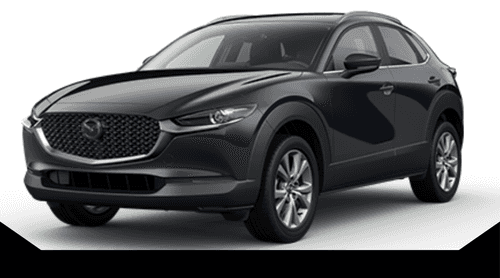
This comparison is designed for northern New Jersey SUV shoppers deciding between a compact, standard-AWD subcompact crossover and a larger, more spacious family-oriented compact SUV. Choose the 2026 Mazda CX-30 if you want standard AWD with Off-road Traction Assist, a 2.5-liter engine with 186 horsepower and 186 lb-ft of torque, available turbo power with up to 250 horsepower and 320 lb-ft of torque using premium fuel, a traditional 6-speed automatic transmission, 8.0 inches of ground clearance, and a lower listed starting price. Choose the 2026 Honda CR-V if you want a larger compact SUV with 39.3 cubic feet of cargo room behind the second row on gas trims, up to 76.5 cubic feet behind the first row on gas trims, 41.0 inches of rear legroom, available Real-Time AWD, available hybrid trims with up to 204 total system horsepower, and better fuel economy.
For northern New Jersey winter driving — including steep driveways, slushy side streets, wet leaves, poorly plowed roads, and hilly neighborhoods in Bergen, Essex, Hudson, Union, Morris, Sussex, Warren, and Passaic counties — the CX-30 has the stronger standard-traction story because AWD is included on every trim, while the CR-V is still a strong winter choice when equipped with available Real-Time AWD. For daily commuting on Route 17, Route 46, I-80, I-287, Route 3, the Garden State Parkway, or the New Jersey Turnpike, the CR-V has the efficiency advantage. For shoppers in denser areas where parking, narrow streets, and tight apartment garages are daily realities, the CX-30’s smaller 173.0-inch-long footprint is a practical benefit, while families and suburban commuters who need rear-seat space and cargo room will find the CR-V more capable. The core difference between the Mazda CX-30 vs. Honda CR-V comes down to size: the CX-30 is easier to park and more engaging to drive, while the CR-V is more spacious and more practical for families.

The 2026 Mazda CX-30 is a five-passenger subcompact crossover SUV offered in eight AWD trims, including naturally aspirated 2.5-liter models producing 186 horsepower and turbocharged 2.5-liter models producing up to 250 horsepower with premium fuel, all equipped with i-ACTIV AWD with Off-road Traction Assist and a SKYACTIV-Drive 6-speed automatic transmission with manual-shift mode. The 2026 Honda CR-V is a five-passenger compact crossover SUV offered in seven trims spanning gasoline and hybrid powertrains, with gas trims using a 1.5-liter turbocharged inline-4 engine paired with a CVT and hybrid trims using a 2.0-liter hybrid system with a direct drive unit, available in front-wheel drive or Real-Time AWD with Intelligent Control System depending on trim. All-wheel drive sends power to more than one axle for improved traction in rain, snow, and low-grip conditions; a CVT changes ratios smoothly without shifting through fixed gears; a traditional automatic transmission shifts through set gears; and a hybrid combines gasoline and electric power to improve efficiency. Together, these two vehicles represent the core choice northern New Jersey SUV shoppers face when deciding between a standard-AWD subcompact with a premium feel and a roomier compact SUV with hybrid availability.
For a practical real-world comparison, this article compares the 2026 Mazda CX-30 2.5 S Select Sport AWD against the 2026 Honda CR-V EX AWD — two trims that sit above the base level, serve as capable daily drivers, and represent each brand’s standard value proposition for northern New Jersey SUV shoppers. The CX-30 2.5 S Select Sport highlights Mazda’s standard-AWD value and premium small-SUV feel at a listed price of $27,660, while the CR-V EX AWD highlights Honda’s larger compact-SUV practicality starting at $33,150 for EX 2WD before adding AWD. Both trims sit above the base trim, serve as practical daily drivers, and focus on useful comfort, safety, and everyday value, making this a representative comparison for shoppers evaluating the Mazda CX-30 vs. Honda CR-V in the same budget and use-case range.
| Category | 2026 Mazda CX-30 2.5 S Select Sport AWD | 2026 Honda CR-V EX AWD | Winner |
|---|---|---|---|
| Segment | Subcompact crossover SUV | Compact crossover SUV | Depends on size preference |
| Listed starting price | $27,660 | $33,150 for EX 2WD; AWD available | CX-30 |
| Seating | 5 passengers | 5 passengers | Tie |
| Drivetrain | AWD standard | 2WD standard, AWD available | CX-30 for standard traction |
| Standard engine | 2.5L SKYACTIV-G 4-cylinder | 1.5L turbocharged inline-4 | Depends on preference |
| Horsepower | 186 hp | 190 hp | CR-V by a small margin |
| Torque | 186 lb-ft | 179 lb-ft | CX-30 by a small margin |
| Transmission | 6-speed automatic | CVT | CX-30 for traditional automatic feel; CR-V for smoothness |
| Fuel economy | 24 / 31 / 27 mpg | AWD: 27 / 31 / 29 mpg | CR-V |
| Ground clearance | 8.0 in | Available AWD configuration | CX-30 for known clearance and standard AWD |
| Cargo behind second row | 20.2 cu ft | 39.3 cu ft | CR-V |
| Passenger volume | 94.1 cu ft | 103.5 cu ft | CR-V |
| Front legroom | 41.7 in | 41.3 in | CX-30 by a small margin |
| Rear legroom | 36.3 in | 41.0 in | CR-V |
| Center display | 8.8-inch center display | Honda infotainment varies by trim | Use-case split |
| Driver-assistance suite | Mazda i-Activsense features including Mazda Radar Cruise Control, lane-support features, Blind Spot Monitoring, Rear Cross Traffic Alert, Vehicle Exit Warning, and Smart Brake Support | Honda Sensing | Tie |
| Best for | Standard AWD, lower price, compact size, premium feel | Passenger room, cargo room, fuel economy, family use | Use-case split |
Reading across the Winner column, several rows resolve as clear advantages and several reflect buyer-preference splits worth unpacking. On pricing and standard traction, the CX-30 wins outright: it costs roughly $5,490 less at the recommended trim level and delivers AWD on every trim without an upgrade decision, while the CR-V requires shoppers to confirm AWD availability and pricing at the EX level. On space and efficiency, the CR-V wins outright: its 39.3 cubic feet of cargo room behind the second row is nearly double the CX-30’s 20.2 cubic feet, its 103.5 cubic feet of passenger volume beats the CX-30’s 94.1 cubic feet, its 41.0 inches of rear legroom substantially exceeds the CX-30’s 36.3 inches, and its AWD fuel economy rating of 27 city / 31 highway / 29 combined mpg edges the CX-30’s 24 city / 31 highway / 27 combined mpg.
The segment row is a buyer-preference split rather than a clear winner. The CX-30 is a subcompact crossover — smaller, easier to park, and more agile in tight spaces — while the CR-V is a compact SUV that is meaningfully larger and more spacious. Neither is objectively better; the right choice depends on whether your northern New Jersey daily life calls for a compact footprint or family-sized room.
The standard engine row is also a preference split. The CX-30 uses a naturally aspirated 2.5-liter four-cylinder that delivers linear, predictable power; the CR-V uses a turbocharged 1.5-liter four-cylinder that produces slightly more peak horsepower. Drivers who prefer a traditional naturally aspirated feel may favor the CX-30; drivers who want turbo efficiency at low RPM may prefer the CR-V’s engine character.
The transmission row is a preference split as well. The CX-30 offers a traditional 6-speed automatic with manual-shift mode, which some drivers prefer for its familiar step-gear feel and engagement. The CR-V offers a CVT, which prioritizes smoothness and efficiency over gear-change character. Neither is a technical disadvantage — this is a driving-feel preference.
On ground clearance, the CX-30’s 8.0 inches of clearance is a known, quantified advantage, and its standard AWD strengthens the winter-traction case. The CR-V’s ground clearance figure was not available in a directly comparable format for this table and requires human verification before a direct numeric comparison can be made. Shoppers evaluating winter capability should confirm the CR-V EX AWD ground clearance figure with a dealer.
On the center display row, the CX-30 2.5 S Select Sport uses an 8.8-inch center display, with higher CX-30 trims moving to a 10.25-inch display with touchscreen functionality. The CR-V’s infotainment display size varies by trim and was not available in a directly comparable format for the EX AWD trim specifically; shoppers should verify the EX AWD display size before making a technology-based decision.
The Best for row summarizes the use-case split that runs through the entire comparison: the CX-30 is the stronger fit for standard AWD, lower price, compact size, and premium small-SUV feel, while the CR-V is the stronger fit for passenger room, cargo room, fuel economy, and family use. There is no single winner — the right vehicle depends entirely on which set of priorities matches your northern New Jersey life.
For northern New Jersey SUV shoppers, the 2026 Mazda CX-30 and 2026 Honda CR-V each win in distinct, clearly defined categories, and the right choice depends entirely on your priorities. The 2026 Mazda CX-30 wins on lower listed pricing ($25,975 starting vs. $30,920 starting), standard AWD on every trim, compact size for easier parking, 8.0 inches of ground clearance, traditional 6-speed automatic transmission feel, available turbocharged performance reaching 250 horsepower and 320 lb-ft with premium fuel, and premium small-SUV character — making it the stronger fit for commuters, singles, couples, and small families in denser areas such as Bergen, Essex, Hudson, and Union counties where parking, traffic, and a smaller footprint matter. The 2026 Honda CR-V wins on passenger room (103.5 cubic feet vs. 94.1 cubic feet), rear-seat space with 41.0 inches of rear legroom, cargo capacity with 39.3 cubic feet behind the second row on gas trims, fuel economy with AWD trims rated at 27 city / 31 highway / 29 combined mpg, available hybrid efficiency delivering up to 40 combined mpg with AWD, and family practicality — making it the stronger fit for families and suburban commuters in Morris, Sussex, Warren, and northern Bergen County where space, road-trip comfort, and everyday utility matter most. For northern New Jersey shoppers who want the more affordable, easier-to-park, AWD-standard SUV with premium small-crossover character and winter confidence at lower cost, the CX-30 is the better fit; for shoppers who want the roomier, more efficient, more family-friendly SUV with significantly more cargo space, better fuel economy, and available hybrid power, the CR-V is the stronger practical choice.
The Mazda CX-30 is better overall for shoppers who want lower listed pricing, standard AWD, a smaller footprint, available turbo performance, and a premium small-SUV feel. The Honda CR-V is better overall for shoppers who want more passenger room, more cargo space, better fuel economy, hybrid availability, and family-friendly practicality.
The Mazda CX-30 has the lower listed starting price. The 2026 CX-30 2.5 S starts at $25,975, while the 2026 Honda CR-V LX starts at $30,920.
The CX-30 2.5 S Select Sport AWD is better for lower listed pricing, standard AWD, torque, ground clearance, smaller dimensions, and premium small-SUV feel. The CR-V EX AWD is better for horsepower, fuel economy, passenger volume, rear legroom, cargo space, and family practicality.
In the recommended trim comparison, the CR-V has slightly more horsepower (190 hp vs. 186 hp) and the CX-30 has slightly more torque (186 lb-ft vs. 179 lb-ft). CX-30 turbo trims offer up to 250 horsepower and 320 lb-ft of torque with premium fuel.
The Honda CR-V gets better gas mileage. Gas CR-V AWD trims are rated at 27 city / 31 highway / 29 combined mpg, while Mazda CX-30 2.5 S AWD trims are rated at 24 city / 31 highway / 27 combined mpg. CR-V hybrid trims are more efficient still, reaching up to 40 city / 34 highway / 37 combined mpg on Sport-L Hybrid AWD and Sport Touring Hybrid AWD trims.
The Mazda CX-30 is better if you want AWD standard on every trim, along with 8.0 inches of ground clearance. The Honda CR-V is better if you want available AWD in a larger, roomier SUV. Both can be strong winter choices when equipped with proper tires.
Yes. Every 2026 Mazda CX-30 trim includes i-ACTIV AWD with Off-road Traction Assist as standard equipment.
Yes. The 2026 Honda CR-V offers Real-Time AWD with Intelligent Control System on many trims, and AWD is standard on several hybrid trims including TrailSport Hybrid, Sport-L Hybrid, and Sport Touring Hybrid.
The Honda CR-V has much more cargo space. Gas CR-V trims offer 39.3 cubic feet behind the second row and 76.5 cubic feet behind the first row. The Mazda CX-30 offers 20.2 cubic feet behind the second row.
The Honda CR-V has more passenger room. The CR-V EX has 103.5 cubic feet of passenger volume, while the CX-30 2.5 S Select Sport has 94.1 cubic feet. The CR-V also has 41.0 inches of rear legroom compared with 36.3 inches in the CX-30.
The Mazda CX-30 has a clear premium technology path, with available wireless smartphone integration, Alexa Built-in, a 10.25-inch center display on higher trims, Bose 12-speaker audio, Traffic Sign Recognition, and 360-degree camera technology depending on trim. The CR-V includes Honda Sensing and a broad gas and hybrid trim lineup with technology that varies by trim level.
Both SUVs include strong safety technology. The CX-30 includes Mazda i-Activsense features such as Mazda Radar Cruise Control with Stop and Go, Lane Departure Warning, Lane-keep Assist, Driver Attention Alert, Blind Spot Monitoring, Rear Cross Traffic Alert, Vehicle Exit Warning, and Smart Brake Support. The CR-V includes Honda Sensing Safety and Driver-Assistive Technologies.
The Mazda CX-30 is easier to park because it is smaller, measuring 173.0 inches long and 70.7 inches wide. The CR-V is a larger compact SUV with more passenger and cargo room but a bigger footprint.
The Honda CR-V is better for families because it has more passenger space, 41.0 inches of rear legroom, and significantly more cargo room (39.3 cubic feet vs. 20.2 cubic feet behind the second row). The CX-30 is better for singles, couples, commuters, and small families who value standard AWD, lower pricing, and easier parking.
Choose the CX-30 Turbo if you want stronger acceleration, standard AWD, a smaller footprint, and up to 250 horsepower and 320 lb-ft of torque with premium fuel. Choose the CR-V Hybrid if you want better fuel economy (up to 40 combined mpg with AWD), more passenger space, more cargo room, and a more family-focused SUV.
This 2026 Mazda CX-30 vs. 2026 Honda CR-V comparison is written for northern New Jersey shoppers, reflecting local driving conditions, seasonal road challenges, and the SUV priorities of shoppers in Bergen, Essex, Hudson, Union, Morris, Sussex, Warren, and Passaic counties. Specifications, pricing, and fuel economy figures cited throughout this article reflect the 2026 model year and are intended to serve as real-world comparison points for the recommended trims. Pricing reflects listed starting figures and does not include destination charges, dealer fees, taxes, or optional equipment. Shoppers are encouraged to verify current pricing, trim availability, and AWD configuration details with a sales representative, as specifications and dealer inventory are subject to change. This comparison is intended as a general buying guide.


