The 2026 Jeep Grand Cherokee L and the 2026 Ford Explorer are both three-row midsize SUVs built for families, commuting, school runs, winter driving, weekend travel, light towing, and everyday utility. For northern New Jersey SUV shoppers, the right choice depends on what matters most: towing and upscale Jeep comfort, or stronger performance, better fuel economy, and Ford’s tech-forward three-row layout.
This comparison is written specifically for northern New Jersey families shopping for a three-row midsize SUV. The scope covers the 2026 Jeep Grand Cherokee L and the 2026 Ford Explorer across performance, fuel economy, seating, cargo, towing, winter driving, technology, safety, ride character, and ownership value. The comparison focuses on the Laredo 4WD and Explorer Active with Intelligent 4WD as the recommended trim pairing, while noting where higher trims such as Summit, Platinum, and ST change the calculus. Shoppers outside northern New Jersey, or those comparing different model years, may find some details less directly applicable.
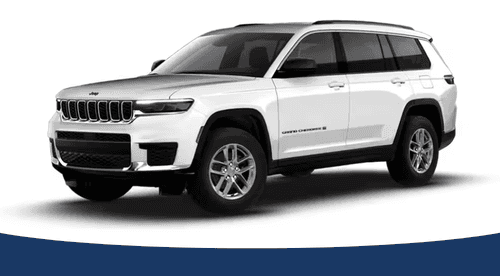
The short answer: the 2026 Jeep Grand Cherokee L is the better choice if you want higher maximum towing, a premium Jeep interior path, available 4WD, a standard 12.3-inch Uconnect 5 NAV touchscreen, and available Hurricane turbo power. The 2026 Ford Explorer is the better choice if you want a lower listed starting price, more standard horsepower and torque in the recommended trim comparison, stronger fuel economy, a larger center display, and available Explorer ST performance. This Jeep Grand Cherokee vs. Ford Explorer comparison gives northern New Jersey families the specific data they need to make a confident decision.
The 2026 Ford Explorer wins on standard horsepower, standard torque, fuel economy, center-display size, available ST performance, and slightly easier-to-manage overall length. The 2026 Jeep Grand Cherokee L wins on maximum towing, standard seven-passenger seating on key trims, second-row legroom, cargo space behind the third row, premium Jeep character, and available 4WD family-SUV capability. For most northern New Jersey families focused on commuting, technology, and everyday efficiency, the Explorer is the stronger practical pick. For families who prioritize towing, Jeep character, upscale comfort, and a more substantial three-row SUV feel, the Grand Cherokee L is the better fit. To confirm which SUV is right for your household, schedule a test drive at Pine Belt Cars so you can experience both vehicles in the conditions that matter most to your northern New Jersey life.
The 2026 Jeep Grand Cherokee L is a three-row midsize SUV offered in Laredo, Laredo X, Laredo Altitude, Limited, 85th Anniversary Edition, Limited Reserve, and Summit trims. It seats 6 or 7 passengers depending on configuration and is offered with rear-wheel drive or 4WD depending on trim. Powertrains include a 3.6L Pentastar V6 with 293 horsepower and 260 lb-ft of torque, plus an available 2.0L Hurricane 4 Turbo — a turbocharged four-cylinder engine producing 324 horsepower and 332 lb-ft of torque — on select trims.
The 2026 Ford Explorer is a three-row midsize SUV offered in Active, ST-Line, Tremor, Platinum, and ST trims. It seats 6 passengers standard on most models, with 7-passenger seating available or standard with a second-row bench depending on trim. Most trims use a 2.3L EcoBoost turbocharged inline-4 — a turbocharged four-cylinder engine producing 300 horsepower and 310 lb-ft of torque — while the Explorer ST uses a 3.0L twin-turbocharged EcoBoost V6 with 385 horsepower and 415 lb-ft of torque.
A three-row SUV has seating across three rows, making it useful for families, carpools, and weekend travel. Rear-wheel drive sends power to the rear wheels. Four-wheel drive, or 4WD, can send power to all four wheels for better traction in snow, wet leaves, gravel, and low-grip conditions. The Hurricane 4 Turbo is Jeep’s 2.0-liter turbocharged four-cylinder engine producing 324 horsepower and 332 lb-ft of torque. Towing capacity refers to how much trailer weight an SUV can pull when properly equipped. Understanding these terms helps shoppers compare the Grand Cherokee L and Explorer on equal footing.
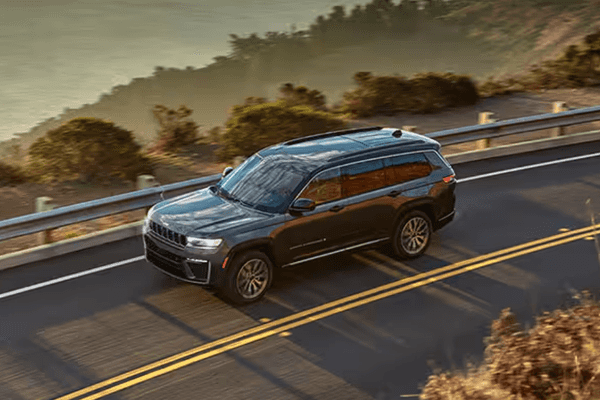
The 2026 Jeep Grand Cherokee L is a three-row midsize SUV offered in Laredo, Laredo X, Laredo Altitude, Limited, 85th Anniversary Edition, Limited Reserve, and Summit trims. It seats 6 or 7 passengers depending on configuration and is offered with rear-wheel drive or 4WD depending on trim.
The 2026 Ford Explorer is a three-row midsize SUV offered in Active, ST-Line, Tremor, Platinum, and ST trims. It seats 6 passengers standard on most models, with 7-passenger seating available or standard with a second-row bench depending on trim.
For a practical real-world comparison, we recommend comparing the 2026 Jeep Grand Cherokee L Laredo 4WD against the 2026 Ford Explorer Active with Intelligent 4WD. These trims represent the everyday entry point for northern New Jersey families who need winter-capable drivetrains, strong standard driver-assistance technology, useful screens, and enough space for kids, passengers, school gear, groceries, luggage, sports bags, and weekend trips. The Grand Cherokee L Laredo 4WD highlights Jeep’s entry three-row 4WD value, while the Explorer Active with Intelligent 4WD highlights Ford’s mainstream three-row family-SUV setup. Choosing the right trim comparison matters because it anchors the buyer’s decision to real-world pricing and equipment rather than best-case specs.
| Category | 2026 Jeep Grand Cherokee L Laredo 4WD | 2026 Ford Explorer Active with Intelligent 4WD | Winner |
|---|---|---|---|
| Segment | Three-row midsize SUV | Three-row midsize SUV | Tie |
| Seating | 7 passengers | 6 standard / 7 available depending on bench configuration | Grand Cherokee L for standard 7-passenger setup |
| Standard engine | 3.6L Pentastar V6 | 2.3L EcoBoost turbo inline-4 | Depends on preference |
| Horsepower | 293 hp | 300 hp | Explorer |
| Torque | 260 lb-ft | 310 lb-ft | Explorer |
| Transmission | 8-speed automatic | 10-speed automatic | Depends on preference |
| Drivetrain | 4WD | Intelligent 4WD available | Tie in this comparison |
| Fuel economy | 18 city / 25 highway / 21 combined mpg | 20 city / 27 highway / 23 combined mpg with 4WD | Explorer |
| Maximum towing | Up to 6,200 lbs | 5,000 lbs | Grand Cherokee L |
| Cargo space | 17.2 cu ft behind third row / 84.6 cu ft maximum | 16.3 cu ft behind third row / 46.0 cu ft behind second row / 85.3 cu ft maximum | Split: Grand Cherokee L behind third row; Explorer maximum |
| Front legroom | 41.3 in | 42.9 in | Explorer |
| Second-row legroom | 39.4 in | 37.0 in | Grand Cherokee L |
| Ground clearance | 8.5 in | Varies by trim; Tremor offers a more rugged setup | Grand Cherokee L in recommended comparison |
| Center display | 12.3-inch Uconnect 5 NAV touchscreen | 13.2-inch center display | Explorer |
| Driver-assistance suite | Blind spot and lane departure warnings, Lane Keep Assist, Rear Cross Traffic Alert, adaptive cruise control, rear parking sensors, and more | Ford Co-Pilot360 Assist+ / Assist 2.0 depending on trim, rear camera, rear parking sensors, Lane Keeping System, and available BlueCruise on select trims | Explorer for broader tech path; Jeep for strong standard content |
| Best for | Towing, second-row space, premium Jeep feel | Power, fuel economy, technology, ST performance | Use-case split |
Translating the table verdicts into buyer consequences clarifies what each winner declaration actually means for a northern New Jersey family.
On standard engine, the table correctly notes that the winner depends on preference — and that preference reflects a genuine powertrain philosophy difference. The Grand Cherokee L’s 3.6L Pentastar V6 is a naturally aspirated engine, while the Explorer’s 2.3L EcoBoost turbo inline-4 delivers stronger torque and better fuel economy, which translates to more confident merging on I-80 and I-287 and lower fill-up costs over time. Buyers who prefer the character of a naturally aspirated V6 will favor the Grand Cherokee L; buyers who prioritize peak output and efficiency at the entry trim will favor the Explorer.
On transmission, both the Grand Cherokee L’s 8-speed automatic and the Explorer’s 10-speed automatic are modern units well-suited to three-row SUV duty. Neither transmission is a liability; the difference is a matter of engineering approach rather than a clear quality gap.
On ground clearance, the Grand Cherokee L’s 8.5-inch figure is a single consistent measurement across its lineup. The Explorer’s ground clearance varies by trim, and the table reflects that variability honestly. Buyers considering the Explorer Tremor should note that it offers rugged positioning beyond what the Active trim provides, making it the natural Explorer choice for buyers who want rough-road and winter-ready capability comparable to the Grand Cherokee L’s 4WD identity.
On driver-assistance, the Explorer offers a broader technology path: available BlueCruise and 360 Degree Camera on higher trims give it an advantage for buyers who want more advanced features. The Grand Cherokee L delivers strong standard content — including adaptive cruise control, blind-spot monitoring, lane keep assist, rear cross-traffic alert, and available Hands-Free Active Driving Assist — making it competitive for buyers who want capable assistance features without moving far up the trim ladder. Buyers should confirm exact availability by trim with their dealer.
On the overall use-case split, the Grand Cherokee L excels in three areas that matter most to a specific type of northern New Jersey buyer: towing capacity up to 6,200 pounds, second-row passenger space with 39.4 inches of legroom, and a premium Jeep feel that becomes more pronounced as shoppers move into Limited, Limited Reserve, and Summit trims. The Explorer excels for buyers whose priorities run in a different direction — stronger standard power, better fuel economy on the daily commute, a larger 13.2-inch center display, and available ST performance with 385 horsepower. Neither SUV is the universal winner; the right choice depends on which set of advantages aligns with how the vehicle will actually be used.
Powertrains include a 3.6L Pentastar V6 with 293 horsepower and 260 lb-ft of torque, plus an available 2.0L Hurricane 4 Turbo — a turbocharged four-cylinder engine producing 324 horsepower and 332 lb-ft of torque — on select trims.
Most trims use a 2.3L EcoBoost turbocharged inline-4 — a turbocharged four-cylinder engine producing 300 horsepower and 310 lb-ft of torque — while the Explorer ST uses a 3.0L twin-turbocharged EcoBoost V6 with 385 horsepower and 415 lb-ft of torque.
The Grand Cherokee L’s 3.6L Pentastar V6 is a naturally aspirated engine, while the Explorer’s 2.3L EcoBoost turbo inline-4 delivers stronger torque and better fuel economy, which translates to more confident merging on I-80 and I-287 and lower fill-up costs over time. Buyers who prefer the character of a naturally aspirated V6 will favor the Grand Cherokee L; buyers who prioritize peak output and efficiency at the entry trim will favor the Explorer.
The Explorer’s 2.3L EcoBoost turbo inline-4 delivers stronger torque and better fuel economy, which translates to more confident merging on I-80 and I-287 and lower fill-up costs over time.
The Explorer with 4WD is rated at 20 city / 27 highway / 23 combined mpg. The Grand Cherokee L Laredo 4WD is rated at 18 city / 25 highway / 21 combined mpg.
The 2026 Jeep Grand Cherokee L seats 6 or 7 passengers depending on configuration. The 2026 Ford Explorer seats 6 passengers standard on most models, with 7-passenger seating available or standard with a second-row bench depending on trim.
The Grand Cherokee L offers 41.3 inches of front legroom and 39.4 inches of second-row legroom. The Explorer offers 42.9 inches of front legroom and 37.0 inches of second-row legroom.
The Grand Cherokee L has slightly more cargo space behind the third row, with 17.2 cubic feet compared with 16.3 cubic feet in the Explorer. The Explorer has slightly more maximum cargo space, with 85.3 cubic feet compared with 84.6 cubic feet in the Grand Cherokee L.
The answer depends on how you use the cargo area. The Grand Cherokee L has slightly more cargo space behind the third row. The Explorer has slightly more maximum cargo space.
The Jeep Grand Cherokee L can tow more. It is rated at up to 6,200 pounds when properly equipped. The Ford Explorer is rated at 5,000 pounds.
The Grand Cherokee L excels in three areas that matter most to a specific type of northern New Jersey buyer: towing capacity up to 6,200 pounds, second-row passenger space with 39.4 inches of legroom, and a premium Jeep feel that becomes more pronounced as shoppers move into Limited, Limited Reserve, and Summit trims.
Four-wheel drive, or 4WD, can send power to all four wheels for better traction in snow, wet leaves, gravel, and low-grip conditions.
The Grand Cherokee L is offered with rear-wheel drive or 4WD depending on trim. The Explorer can be configured with Intelligent 4WD.
Both SUVs can be strong winter choices when equipped with 4WD and proper tires. The Grand Cherokee L is better for shoppers who want Jeep 4WD character and towing capability. The Explorer is better for shoppers who want Intelligent 4WD with better fuel economy and available Tremor positioning.
Buyers considering the Explorer Tremor should note that it offers rugged positioning beyond what the Active trim provides, making it the natural Explorer choice for buyers who want rough-road and winter-ready capability comparable to the Grand Cherokee L’s 4WD identity.
The Grand Cherokee L includes a standard 12.3-inch Uconnect 5 NAV touchscreen. The Explorer includes a 13.2-inch center display.
The Ford Explorer has the stronger technology package because it includes a 13.2-inch center display, wireless Apple CarPlay and Android Auto compatibility, 4G/5G modem, and multi-row USB ports. The Grand Cherokee L also has a strong setup with a 12.3-inch Uconnect 5 NAV touchscreen.
The Explorer offers a broader technology path: available BlueCruise and 360 Degree Camera on higher trims give it an advantage for buyers who want more advanced features.
The Grand Cherokee L includes blind spot and lane departure warnings, Lane Keep Assist, Rear Cross Traffic Alert, adaptive cruise control, rear parking sensors, and available Hands-Free Active Driving Assist. The Explorer includes Ford Co-Pilot360 Assist+ or Assist 2.0 depending on trim, rear parking sensors, Lane Keeping System, available 360 Degree Camera, and BlueCruise availability or trial access on select trims.
Both SUVs have strong driver-assistance content. The Grand Cherokee L delivers strong standard content — including adaptive cruise control, blind-spot monitoring, lane keep assist, rear cross-traffic alert, and available Hands-Free Active Driving Assist — making it competitive for buyers who want capable assistance features without moving far up the trim ladder. Buyers should confirm exact availability by trim with their dealer.
The Explorer offers a broader technology path: available BlueCruise and 360 Degree Camera on higher trims give it an advantage for buyers who want more advanced features.
Both the Grand Cherokee L’s 8-speed automatic and the Explorer’s 10-speed automatic are modern units well-suited to three-row SUV duty. Neither transmission is a liability; the difference is a matter of engineering approach rather than a clear quality gap.
The Grand Cherokee L’s 3.6L Pentastar V6 is a naturally aspirated engine, while the Explorer’s 2.3L EcoBoost turbo inline-4 delivers stronger torque and better fuel economy, which translates to more confident merging on I-80 and I-287 and lower fill-up costs over time.
The Ford Explorer has the stronger entry-price case because the Explorer lineup starts lower than the Grand Cherokee L lineup. The Grand Cherokee L Laredo starts at $40,415 with rear-wheel drive and $42,415 with 4WD.
All vehicle specifications, powertrain figures, fuel economy ratings, towing capacities, cargo measurements, and feature descriptions in this comparison are drawn from manufacturer and trusted third-party sources. Feature availability varies by trim and configuration; buyers should confirm exact specifications with their dealer before purchase. This page was prepared by Pine Belt Cars to help northern New Jersey families make a confident, well-informed decision between the 2026 Jeep Grand Cherokee L and the 2026 Ford Explorer.
Use the following numbered decision workflow to identify which three-row SUV is the right fit for your northern New Jersey household.
Your next step: visit Pine Belt Cars in northern New Jersey to schedule a test drive in both the Grand Cherokee L and the Explorer so you can confirm which SUV fits your driveway, your family, and your daily commute.
For northern New Jersey families, the 2026 Jeep Grand Cherokee L makes the most sense if you want a premium-feeling three-row SUV with stronger towing capability, available 4WD, standard seven-passenger seating on many trims, and useful space behind the third row. It is especially appealing for families who tow, take weekend trips, drive in snowy or hilly areas, or want a more upscale Jeep alternative to a mainstream three-row SUV. The Grand Cherokee L is a strong fit for suburban and outdoor-oriented areas such as Morris, Sussex, Warren, Passaic, and northern Bergen County, where winter traction, towing, road-trip comfort, and hilly terrain may matter more.
The Ford Explorer makes the most sense if you want a three-row SUV with better fuel economy, stronger standard turbo power, a more advanced digital cabin, available Intelligent 4WD, and performance-oriented trims. It is especially appealing for families who commute often, use major highways daily, or want a more responsive SUV with a strong technology story. The Explorer is a strong fit for dense northern New Jersey areas where parking, commuting, and highway efficiency matter, including Bergen, Essex, Hudson, Union, and parts of Passaic County.
The 2026 Ford Explorer wins on standard horsepower, standard torque, fuel economy, center-display size, available ST performance, and slightly easier-to-manage overall length. The 2026 Jeep Grand Cherokee L wins on maximum towing, standard seven-passenger seating on key trims, second-row legroom, cargo space behind the third row, premium Jeep character, and available 4WD family-SUV capability. For most northern New Jersey families focused on commuting, technology, and everyday efficiency, the Explorer is the stronger practical pick. For families who prioritize towing, Jeep character, upscale comfort, and a more substantial three-row SUV feel, the Grand Cherokee L is the better fit. To confirm which SUV is right for your household, schedule a test drive at Pine Belt Cars so you can experience both vehicles in the conditions that matter most to your northern New Jersey life.
The Ford Explorer is better overall for shoppers who want stronger standard power, better fuel economy, a larger center display, and available ST performance. The Jeep Grand Cherokee L is better for shoppers who want higher towing capacity, a premium Jeep feel, standard seven-passenger seating on key trims, and available 4WD capability.
The Ford Explorer has the stronger entry-price case because the Explorer lineup starts lower than the Grand Cherokee L lineup. The Grand Cherokee L Laredo starts at $40,415 with rear-wheel drive and $42,415 with 4WD.
The Explorer Active with Intelligent 4WD is better for horsepower, torque, fuel economy, center-display size, and digital cabin technology. The Grand Cherokee L Laredo 4WD is better for towing, standard seven-passenger seating, second-row legroom, cargo space behind the third row, and Jeep SUV character.
The Ford Explorer has more standard horsepower and torque. Its 2.3L EcoBoost turbocharged engine makes 300 horsepower and 310 lb-ft of torque. The Grand Cherokee L’s standard 3.6L V6 makes 293 horsepower and 260 lb-ft of torque.
The Ford Explorer ST has the strongest engine in this comparison. Its 3.0L twin-turbocharged EcoBoost V6 makes 385 horsepower and 415 lb-ft of torque. The strongest Grand Cherokee L engine listed here is the 2.0L Hurricane 4 Turbo with 324 horsepower and 332 lb-ft of torque.
The Ford Explorer gets better gas mileage in the recommended comparison. The Explorer with 4WD is rated at 20 city / 27 highway / 23 combined mpg. The Grand Cherokee L Laredo 4WD is rated at 18 city / 25 highway / 21 combined mpg.
The Jeep Grand Cherokee L can tow more. It is rated at up to 6,200 pounds when properly equipped. The Ford Explorer is rated at 5,000 pounds.
The answer depends on how you use the cargo area. The Grand Cherokee L has slightly more cargo space behind the third row, with 17.2 cubic feet compared with 16.3 cubic feet in the Explorer. The Explorer has slightly more maximum cargo space, with 85.3 cubic feet compared with 84.6 cubic feet in the Grand Cherokee L.
Both SUVs can be strong winter choices when equipped with 4WD and proper tires. The Grand Cherokee L is better for shoppers who want Jeep 4WD character and towing capability. The Explorer is better for shoppers who want Intelligent 4WD with better fuel economy and available Tremor positioning.
The Ford Explorer has the stronger technology package because it includes a 13.2-inch center display, wireless Apple CarPlay and Android Auto compatibility, 4G/5G modem, and multi-row USB ports. The Grand Cherokee L also has a strong setup with a 12.3-inch Uconnect 5 NAV touchscreen.
Both SUVs have strong driver-assistance content. The Grand Cherokee L includes blind spot and lane departure warnings, Lane Keep Assist, Rear Cross Traffic Alert, adaptive cruise control, rear parking sensors, and available Hands-Free Active Driving Assist. The Explorer includes Ford Co-Pilot360 Assist+ or Assist 2.0 depending on trim, rear parking sensors, Lane Keeping System, available 360 Degree Camera, and BlueCruise availability or trial access on select trims.
The Grand Cherokee L is better for families who want standard seven-passenger seating on key trims, strong second-row space, more cargo room behind the third row, and higher towing capacity. The Explorer is better for families who want better fuel economy, stronger standard power, more advanced display technology, and available performance trims.
The Ford Explorer is easier to recommend for tighter parking because it is shorter. The Explorer is 198.7 inches long, while the Grand Cherokee L is 204.9 inches long. Both are three-row midsize SUVs, so shoppers should still test driveway, garage, and parking-lot fit.
Choose the Grand Cherokee L Summit if you want the upper Jeep trim with 4WD, Hurricane turbo power, premium luxury content, and a towing-focused SUV identity. Choose the Explorer Platinum if you want Ford’s premium three-row SUV with advanced technology, comfort features, and available driver-assistance content.
Choose the Explorer ST if performance is the priority. Its 3.0L twin-turbocharged EcoBoost V6 makes 385 horsepower and 415 lb-ft of torque. Choose the Grand Cherokee L if towing capacity, Jeep styling, premium comfort, and three-row family utility matter more than outright performance.
The Jeep Grand Cherokee vs. Ford Explorer decision is particularly relevant for northern New Jersey families because regional factors — winter snow, hilly terrain in Morris, Sussex, and Warren counties, dense parking in Bergen and Essex, and daily highway commuting on the Parkway, Turnpike, I-80, and I-287 — directly influence which SUV’s strengths matter most.


